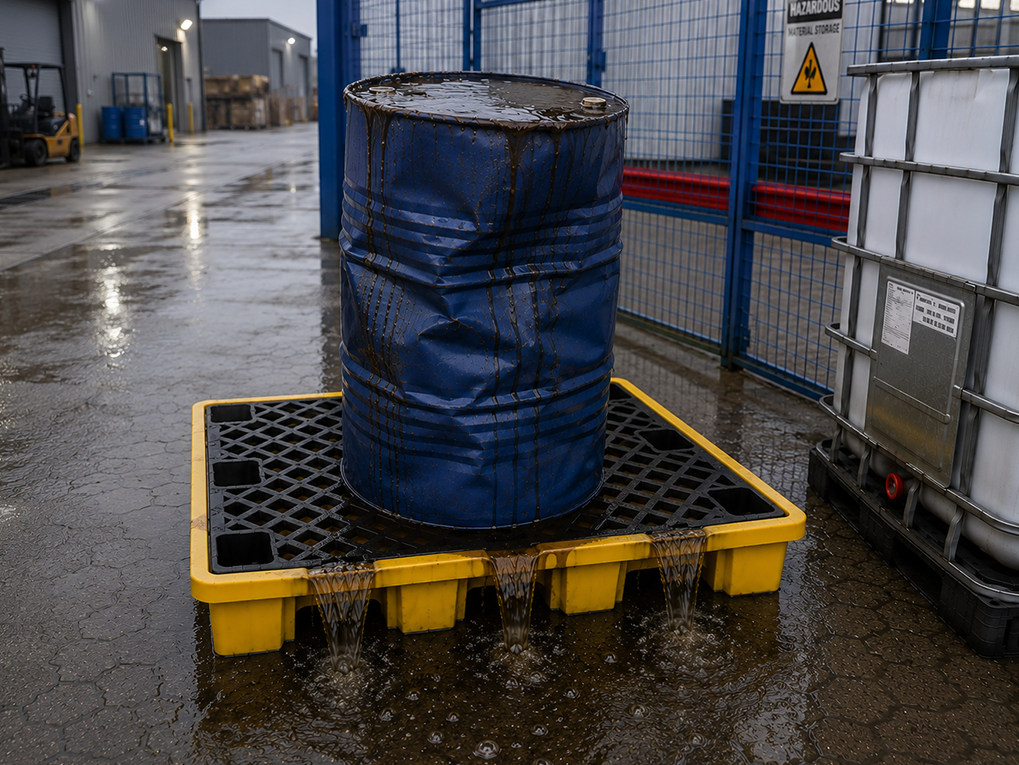
You may never have seen a UFO – but many businesses have encountered UCW – Unidentified Chemical Waste.
It usually shows up quietly – a cupboard of old unlabelled bottles, the odd mystery drum in the corner of a warehouse, the box of ‘lab leftovers’ with no paperwork. It’s especially common after staff turnover, site shutdowns, refurbishments or when Facilities Management (FM) teams take on a new contract and inherit whatever the previous incumbent left behind.
If you don’t know exactly what a substance is, you can’t safely store it, transport it, classify it, or dispose of it. And when ‘mystery chemicals’ sit around long enough, they get more unstable, more expensive to remove, and more likely to cause an incident.
This guide explains how UK businesses should approach unknown chemical disposal safely, legally, and without guesswork.
- What Counts as ‘Unknown Chemicals’?
- What to Do if You Find Unknown Chemicals on Site
- 5 Things to Never Do with Unknown Chemical Waste
- Triage the Risk Before You Do Anything
- The Usual Suspects: Legacy and Out-of-Date Chemicals
- The Compliant Route for Unknown Chemical Disposal
- How to Prevent Unknown Chemical Buildup
What Counts as ‘Unknown Chemicals’?
We’ve already covered the definition of ‘chemical waste’, and ‘how to dispose of chemical waste’ in other blogs, so for the purposes of this one, unidentified chemical waste includes any substance for which you cannot confidently confirm what it is and how it should be handled. This might be:
- Containers with missing, damaged, faded, or handwritten labels.
- Decanted liquids in unmarked bottles (a classic on industrial sites).
- Mixed containers with no Safety Data Sheet (SDS).
- Old stock with no purchase records following ownership or management changes.
- Drums or IBCs where the contents don’t match the label.
- Lab chemicals past their use-by date with unclear history.
- Waste containers where streams may have been mixed.
Many substances are colourless, and some of the most problematic materials only become obvious when something goes wrong – vapours, reactions, pressure build-up, corrosion, or leaks.
As a rule, if you can’t confidently identify a substance, it should be treated as potentially hazardous until assessed, even if it looks harmless.
When Does a Chemical Become Waste?
This is an important legal point under UK waste legislation, as a chemical isn’t considered waste until the holder:
- Discards it,
- Intends to discard it,
- Or is required to discard it.
Old stock sitting in stores isn’t automatically considered as waste. However, once a decision is made to remove it – because it’s redundant, out of date, or no longer usable – hazardous waste regulations may apply.
What to Do if You Find Unknown Chemicals on Site
If you’ve found mystery containers and you’re wondering what to do, here are the immediate actions you should take:
- Stop and assess. Don’t rush into tidying up.
- Restrict access. Isolate the unknown chemicals and limit handling to trained personnel to avoid accidental use.
- Don’t open, sniff, or decant containers. Informal testing methods create incidents – please don’t sniff anything.
- Photograph everything exactly as found. Capture labels, condition, and location.
- Create a basic inventory. Container type, approximate volume, condition, and markings.
- Look for obvious hazards from a safe distance. Leaks, staining, corrosion, crystallisation, bulging lids, strong odours, heat or fumes.
- Keep away from drains and ignition sources. Unknown liquids and solvents can present both fire and environmental risk.
- Separate obvious incompatibles only if safe to do so. For example, acids away from alkalis – but avoid moving containers unnecessarily.
You can also refer to the HSE COSHH guidance for further clarification on safe handling and exposure control. If anything seems off or you spot any obvious hazards, treat it as a higher risk and escalate to a competent waste specialist for response.
Five Things to Never Do with Unknown Chemical Waste
This was almost a list of six things, but we’re confident you won’t try to eat or drink any of the unidentified chemicals… will you? Some mistakes are obvious. Others are surprisingly common – and far more dangerous.
#1 Don’t test it informally.
Mixing small amounts, adding water or using basic test strips on unknown substances can trigger reactions.
#2 Don’t consolidate containers.
The ‘let’s pour all the half bottles together ’ approach is a fast way to create toxic gases or heat-generating reactions. Mixing waste streams without assessment can also change hazard properties and create new classification obligations.
#3 Don’t store unknowns with general waste or in accessible areas.
Unsecured storage increases exposure and liability.
#4 Don’t transport them as a ‘quick job’
Movement of chemicals may fall under dangerous goods regulations and must be properly assessed.
#5 Don’t assume age makes it harmless.
In some cases, age increases instability or container degradation.
When in doubt, treat unknowns as hazardous until identified.
Triage the Risk Before You Do Anything
Not every unknown chemical situation is an emergency. However, a sensible triage approach helps determine urgency.
Low risk indicators (still handle carefully)
- Small sealed containers in good condition.
- Original packaging with partial label info.
- Stored appropriately with no signs of leakage.
Medium risk indicators
- Damaged labels, unknown age, mixed assortment.
- Poor storage conditions (heat, sunlight, near drains).
- Strong smells, minor staining, unknown residues on the outside.
High risk indicators (stop and get specialist help)
- Leaking containers or corrosion.
- Crystallisation or bulging lids.
- Unidentified pressurised containers (aerosols or cylinders).
- Large volumes in drums or IBCs with unclear history.
- Any visible fumes, heat, or reactions.
In most cases, involving a competent hazardous waste specialist is the safest approach. The triage process simply helps you understand the level of urgency.
The Usual Suspects: Legacy and Out-of-Date Chemicals
Unknown chemicals don’t appear out of nowhere; there are patterns, such as sites accumulating ‘just in case’ stock.
On manufacturing sites
- Process changes leave redundant raw materials.
- Shutdowns and decommissioning projects leave partially cleared stores.
- QA reagents remain after testing methods change.
- Maintenance chemicals get forgotten in workshops.
Linking legacy chemicals back to purchase records and Safety Data Sheet documentation makes assessment significantly easier and more cost-effective.
Out-of-date chemicals
Chemical expiration doesn’t always mean unsafe. However, it can mean:
- Degraded containers
- Changed hazard classifications
- Uncertainty around stability
Out-of-date chemical disposal should be treated as a structured compliance and safety task – not a simple housekeeping chore.
Laboratory environments
When it comes to unknown lab waste, some of these open up new cans of worms and introduce their own complexities:
- Decanted bottles with handwritten notes.
- Mixed small volumes and ‘mystery’ sample vials.
- Cabinets inherited after staff turnover.
- Legacy reagents with unclear history.
Delaying action rarely improves the situation. The safest route is usually inventory, secure storage, competent assessment and finally, planned removal – as opposed to “Let’s deal with it on a quiet Friday…”
Who Is Responsible for Unknown Chemical Waste?
Waste responsibility in general is often misunderstood. Under Duty of Care obligations, any business that produces or holds waste is responsible for it from the point of generation through to final disposal. The process involves ensuring that the waste is accurately described, correctly classified, and transferred only to an authorised party.
For Facilities Management providers, responsibility for unknown chemicals should ideally be clarified during contract mobilisation. However, once in control of a premises, there is still a duty to manage risks appropriately – even where materials were left by a previous occupier.
“The previous incumbent left it behind” doesn’t remove the need to manage it safely, or the fact that you’ve inherited the responsibility to do so.
The Compliant Route for Unknown Chemical Disposal
If you’re wondering about the best way to get rid of unknown or unwanted chemicals, here’s what a safe, compliant, and structured approach looks like.
Step One: Site Assessment and Inventory
A structured inventory is the backbone of safe waste removal. You need to identify:
- What containers exist, where they are, their condition and volumes.
- Any visible hazards, and whether anything needs urgent containment.
- A segregation plan to prevent incompatibles from being packed or stored together.
Step Two: Classification, Segregation and Safe Packing
Even if you can’t fully identify every item, you can often classify waste streams sufficiently for safe handling and legal paperwork. Materials can often be assessed using:
- Available documentation
- Packaging information
- Hazard indicators
- Professional judgement
This enables appropriate handling and documentation.
Unknowns are usually managed by:
- Keeping original containers closed and intact where possible.
- Using compatible secondary packaging (overpacks) for any damaged items.
- Separating broad hazard families based on evidence and assessment – not guesswork.
For detailed guidance on waste assessment and hazard classification, refer to the Environment Agency’s WM3: Waste Classification and Technical Guidance.
Step Three: Collection, Documentation and Disposal
Where materials are classified as hazardous, a hazardous waste consignment note will be required. In England and Wales, records must be retained for at least three years.
Transport must be arranged appropriately, and shortcuts at this stage can result in rejected loads, enforcement action or serious incidents.
Final disposal routes depend on classification, hazard properties, and available treatment options.
Mystery chemical disposal is therefore best approached as a managed process – identify what can be identified, control what we can’t, and maintain traceability throughout.
How to Prevent Unknown Chemical Buildup
You’ve got this far, your site is now free of any mystery drums and suspicious liquids, but what’s next? Prevention – the top of the waste hierarchy. Preventing a repeat scenario will save you time, money, and risk.
Practical steps include:
- Introduce a ‘no label, no storage’ rule – if it’s decanted, it must be labelled immediately. Even restaurants have this rule, and let’s face it, unlabelled passata is far less worrisome than pesticides or acids.
- Maintain a chemical register – even a simple spreadsheet will do the job.
- Keep Safety Data Sheets current and accessible.
- Schedule periodic stores audits and clear-outs.
- Improve stock control to reduce redundant chemicals.
For Facilities Management teams, it’s worth building out a mobilisation checklist that includes:
- Walkdowns of stores, plant rooms and labs.
- Photo inventories at handover.
- Clear agreement on responsibility for legacy materials.
Prevention sits at the top of the waste hierarchy. Better upstream control reduces risk, cost, and downstream compliance pressure.
Why Choose Hazport for Help with Unknown Chemical Waste?
At Hazport, we understand the importance of getting your chemical waste identified, classified and removed for disposal with full traceability and compliance assurance. We help businesses across the UK with:
- Expert-led waste audits and risk assessments.
- Customised chemical spill kits and spill station servicing.
- Staff training and emergency support.
- Fast, compliant waste collection and disposal.
Whether you’re dealing with a challenge of legacy chemicals you’ve inherited with a site, or you just need help auditing your stores and classifying mystery waste, we can remove the guesswork to make it simple, compliant and stress-free.
Contact us today to learn more about our chemical waste disposal services and how we can help you create a safer and more compliant waste management system for your facility.