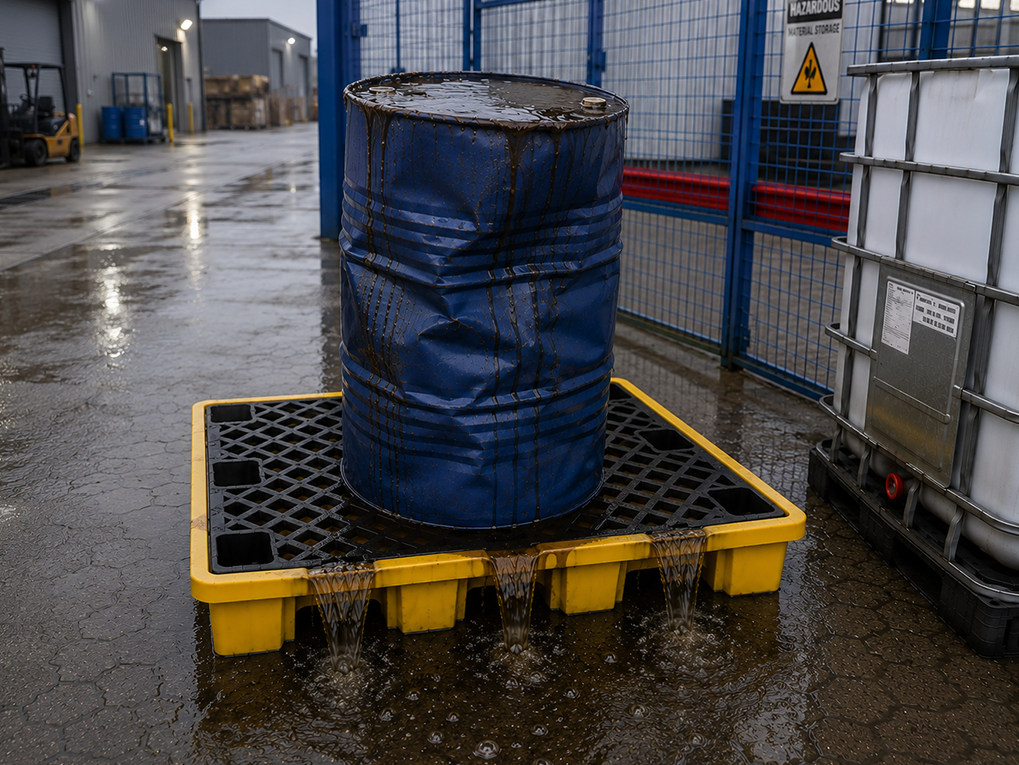
Most hazardous waste storage issues don’t begin with a dramatic incident. They build quietly in the background: a container left unlabeled after a busy shift, an old chemical pushed to the back of the store, a lid left loose because someone was ‘just coming back to it’…
The paperwork may look tidy, the waste transfer notes filed and the collection schedule in the diary. But your waste area often reveals what’s really going on. A quick walkaround will never replace a formal waste audit, and it shouldn’t be treated as a technical classification exercise. However, it can help you spot early warning signs before they become bigger problems.
So, give yourself five minutes to take a practical look at what your waste area is trying to tell you.
Why a Five-Minute Waste Area Walkaround Matters
Under the UK Waste Duty of Care, businesses that produce, keep, carry, treat or dispose of waste are expected to take reasonable steps to manage it safely and legally. An important part of the responsibility is making sure waste is properly described, stored and transferred through the right route.
When it comes to hazardous waste, the details matter even more. Any hazardous waste moved from business premises must be accompanied by a correctly completed consignment note, and the producer or holder must know key information, such as the correct waste classification code and details about the waste.
That’s where the walkaround becomes useful. It helps you check whether the on-site physical reality matches what your paperwork says. If your documentation says one thing but your waste area says another, chances are it’ll be your waste area that holds the truth.
 Where Should You Start Your Walkaround?
The most effective place to start is at the entrance to your waste area. Before you even begin looking at individual containers or bins, ask yourself a simple but important question: Would a new starter understand what this area is for, and how it should be kept?
A well-managed hazardous waste storage area should feel intentional. That doesn’t mean over-engineered or spotless, but it should be clear straight away where waste belongs, which containers are in use, and who’s responsible for the area.
What are the early warning signs to watch out for at this point?
- Waste stored outside the designated area
- Pallets, drums or IBCs blocking access
- No obvious signage
- Waste containers appearing in random corners of the site
- ‘Temporary’ storage areas that seem to have become permanent
That last one deserves ongoing attention. One temporary waste storage point can be useful during maintenance, shutdowns or deep cleans, but several temporary storage areas usually suggest a broken system, or at the very least, a breaking system which is becoming harder to control. The more places waste can gather, the greater the chance that issues like mislabelling, poor segregation, spill risk, and missed collections become the norm.
The Telltale Signs Your Waste Area Needs Attention
Most hazardous waste issues don’t announce themselves with flashing lights and alarms. Instead, they reveal themselves through small clues that are easy to overlook until they become part of the everyday scenery. During your walkaround, these are the telltale signs to look out for.
Individually, they might seem minor, but together they can point to gaps in storage practices, waste segregation, or broader compliance processes.
 Tell #1: Containers with No Labels
Unlabelled containers are one of the clearest signs that a waste area needs attention. A missing label creates uncertainty about what the waste is, posing problems for everyone who comes into contact with the unknown waste.
The questions it gives rise to go beyond “What’s in this container?” to also include:
- Is the waste hazardous?
- Is it compatible with the container?
- Can it be safely moved?
- Has it been mixed with anything else?
- What should happen if it leaks or spills?
Labelling waste isn’t a simple admin task you can leave for another time. It helps communicate risk quickly and clearly. HSE guidance on chemical labelling and packaging covers hazard labels, pictograms, hazard statements and related information used to communicate chemical hazards.
During your walkaround, keep an eye out for containers with missing, damaged, faded or handwritten labels that are too vague to be useful. A good label should help someone understand what the waste is rather than leave them guessing.
Tell #2: Open Lids, Loose Caps and ‘Nearly Closed’ Containers
Unclosed containers are another common giveaway. Sometimes the reason is innocent enough – someone has just added waste, someone is waiting for the container to cool, someone can’t find the right lid, etc.
But open lids can create avoidable problems, especially with liquids, vapours, odours, reactive materials or wastes that could be contaminated by rainwater, dust or other substances.
As you inspect the area, look out for:
- Open drums
- Loose bungs
- IBC caps left off
- Containers with funnels left in place
- Waste bags left untied
- Lids that don’t fit the container properly
If containers are regularly left open, the issue may not be carelessness, but that the container type is wrong for the way waste is generated. In that case, the fix might be a better container, clearer process, or a more convenient disposal point.
Tell #3: Mixed Packaging and ‘Mystery’ Pallets
A pallet with different containers on it isn’t necessarily a problem, but a pallet with unknown bottles, damaged tubs, old aerosols, leaking cans and a few unlabelled jars stuffed into a box is a very different matter.
Mixed packaging often suggests that waste has been gathered quickly without enough thought given to compatibility, classification or onward handling. It’s especially common after clearouts, refurbishments, lab moves, maintenance projects or other similar events.
Watch out for:
- Different waste types stacked together
- Small containers placed loosely inside larger boxes
- Old product containers mixed with waste containers
- Damaged containers wrapped in film instead of assessed
- Waste from different departments consolidated without review
This matters because hazardous waste isn’t only about what something is, but also about what it could react with, how it’s packaged, and how it’ll behave during handling, transport or treatment.
A simple rule of thumb is that if nobody can confidently explain what’s on the pallet, why it’s grouped together and where it’s going next – it needs attention.
 Tell #4: Bulging, Damaged or Stained Containers
Some containers speak louder than others. A bulging drum, a corroded tin, an IBC with residue around the valve or a cracked box – these are not merely cosmetic issues. They can indicate pressure build-up, leakage, poor compatibility, age-related deterioration or rough handling.
Some things to be aware of are:
- Bulging sides or lids
- Rust, corrosion or softening
- Cracks, dents or distorted packaging
- Staining below containers
- Crystallisation around caps or seals
- Strong or unusual smells
- Container sitting directly in pooled liquid
Don’t shake, open, sniff or test unknown containers to investigate. The purpose of the walkaround is to spot and escalate, not turn yourself into a random science experiment. If a container looks unstable, damaged or suspicious, keep people away from it, prevent further handling where possible, and escalate to a competent waste expert.
Tell #5: Waste Stored Near Drains
Drains are often the quickest route from a small site issue to a much larger environmental problem. If liquids, contaminated wash water, oils or chemicals are stored near drains without suitable containment, a leak can spread quickly.
That can create environmental risk, cleanup costs, operational disruption and potential regulatory attention.
Be aware of any waste stored:
- Next to surface water drains
- On uneven ground where spills could run
- Without secondary containment
- In areas exposed to rain
- Near vehicle routes where impact damage is more likely
This is also where bunds come in. A bund is designed to provide secondary containment if a container leaks, spills, or fails, helping prevent polluting liquids from escaping into drains, the ground, or the surrounding environment.
Hazport’s guide to bund emptying and overfilling risks explains why this simple containment measure can be so important in day-to-day site risk management.
Tell #6: Old Stock Mixed with Current Waste
Old stock has a habit of blending into the background. It might be a few redundant chemicals left over from a previous process, out-of-date product, legacy cleaning materials, unidentified containers from an old store, or samples that nobody owns anymore.
The danger is that old stock and current waste are often treated as the same thing, even when they require different handling. Always ask:
- Does this waste relate to a current process?
- Is anyone still responsible for it?
- Is there a date on the container?
- Has it been there longer than expected?
- Is it still in its original packaging?
- Do we know whether it’s waste, product, or unknown material?
Old stock mixed with current waste can create confusion around classification, ownership, storage requirements and disposal route. It can also hide higher-risk materials in plain sight.
If you find old or unknown materials, don’t consolidate them to ‘make space’. Keep them secure while you gather any available information and seek competent support before moving, opening or repackaging them.
Tell #7: Waste That Doesn’t Match Your Site’s Process
This is one of the most useful insider checks. Every site has a waste fingerprint. Manufacturers, labs, facilities management sites, pharmaceutical operations, etc. will usually produce waste streams that make sense for what happens there.
So when something appears that doesn’t seem to fit, pay attention. Examples might include:
- Solvent waste at a site that doesn’t use solvents
- Aerosols in general waste from a process that should segregate them
- Unknown chemical containers in a facilities store
- Batteries or vapes in mixed recycling bins
- Lab-type bottles in a non-lab environment
Unexpected waste can point to process drift, poor segregation, contractor waste entering your system, legacy materials or staff using the wrong disposal route. This is where a quick waste area audit becomes more than a housekeeping check – it becomes a reality check.
If the waste doesn’t match your site’s process, ask where it came from before asking where it should go.
 What to Do When You Spot a Problem
A walkaround is only useful if the issues you find get acted on. For minor issues, such as a missing label on a known container or a lid left open on a low-risk waste stream, the fix may be immediate: relabel, close, tidy, brief the team and record the action.
For more serious issues, such as damaged containers, unknown substances, leaks, fumes, bulging drums or waste stored near drains, don’t guess. Escalate it, restrict access if needed, and involve someone competent or enlist the support of an expert to assess the risk.
If there’s an active spill, release or immediate hazard, follow your site emergency procedures. Hazport’s emergency waste handling guidance outlines why a clear emergency plan matters when hazardous waste incidents do occur.
The True Power of the Walkaround
A good waste area inspection is about catching risks early, not catching people out – hazardous waste storage areas rarely go from perfect to problematic overnight. Most waste storage issues happen because systems are unclear, containers are inconvenient, labels are missing, training hasn’t stuck, or waste ownership falls between departments.
A five-minute walkaround won’t solve every waste compliance challenge in a single day, but it can help you spot the moments where control is starting to slip, and spotting the issue early on is often the difference between a simple fix and a complicated one.
Next time you walk past your waste area, don’t just tick it off as another part of the site. Take five minutes to really look at it. Chances are, it’s already telling you something worth knowing.
After all, your paperwork might tell you how your waste should be managed. Your waste area tells you how it actually is.
 Remove the Guesswork from Your Waste Area
At Hazport, we understand the importance of a safe and compliant waste storage area. We help businesses across the UK with:
- Expert-led waste audits and risk assessments.
- Customised chemical spill kits and spill station servicing.
- Staff training and emergency support.
- Fast, compliant waste collection and disposal.
If your waste area is starting to raise questions, we can help you answer them properly with practical support, clear guidance and waste solutions that stand up to scrutiny. No more guessing, waiting or wondering what that unlabelled drum in your storage area is trying to say.
Contact us today to learn more about our hazardous waste disposal services and how we can help you create a safer and more compliant waste management system for your facility.