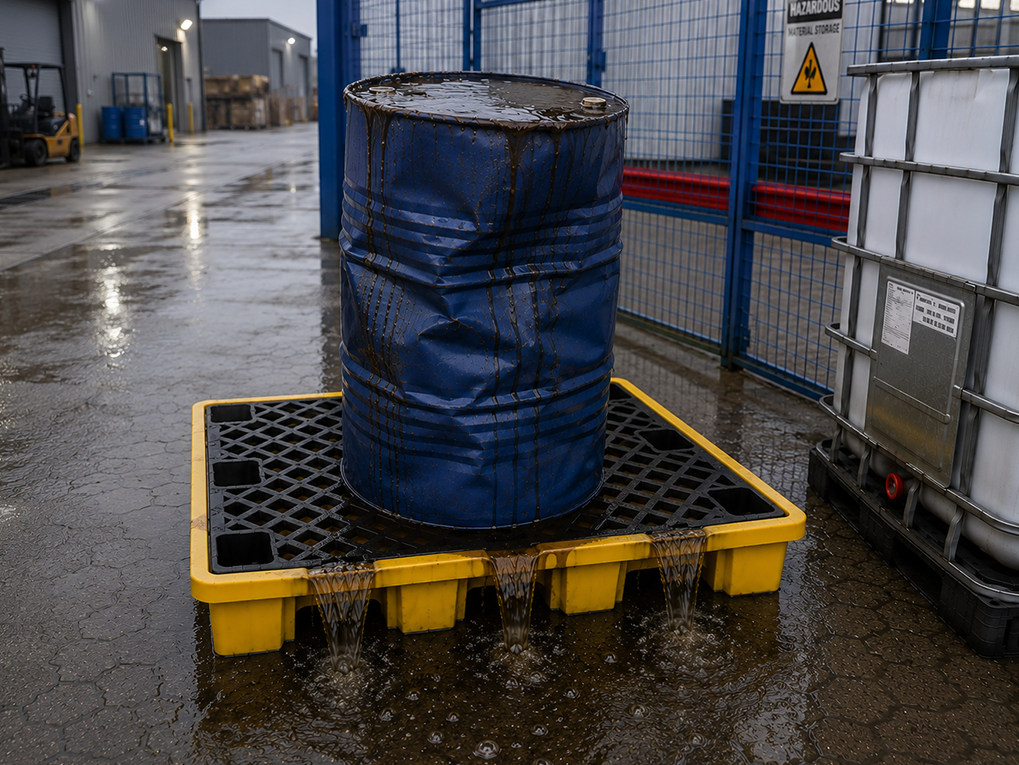
Whether it’s used oils, contaminated absorbents, expired chemicals or empty aerosols, every industrial site has waste streams that are easy to recognise. The waste itself isn’t always an issue – it’s what happens when responsibility for that waste becomes unclear.
Who generated it? Who labelled it? Who checked the container was suitable? Who decided where it should be stored? Who’s arranging collection? When those questions can’t be answered with confidence, responsibility for hazardous waste has already begun to break down.
This is a familiar challenge on busy industrial sites. Maintenance or production teams generate the waste, someone moves it out of the way, facilities may inherit it, and operations may only become involved when a collection is due, an audit is approaching, or a container has started to deteriorate.
Compliance issues usually arise when waste sits between departments, with each team assuming another person or team has it under control. That assumption can turn routine hazardous waste into the most dangerous waste on your site.
 Hazardous Waste Responsibility Begins at the Point of Generation
Hazardous waste responsibility starts at the point of generation, because that’s when the most useful information is still available.
The team that creates the waste is usually closest to the details needed to manage it properly: what process it came from, what materials were involved, whether anything has been mixed, when it was produced, and whether the container still reflects the contents.
Information like that is easiest to capture at the start and becomes much harder to recover days, weeks or months later – especially after a shift change, staff absence or turnover, contractor handover or a site clear-out.
Even if you have a facilities team on-site to coordinate hazardous waste collections, they can’t be expected to identify every container generated by production, maintenance, labs, cleaning teams and contractors.
If the waste knowledge isn’t captured early, the waste can lose its context before it even reaches the storage area. At that point, the disposal route is working with incomplete information. Ownership connects the people who know how the waste was created with the people responsible for storing, describing and arranging its movement.
Where Waste Ownership Commonly Breaks Down
Hazardous waste ownership tends to fail during activities that fall outside the site’s usual rhythm. A routine waste stream with a known container, agreed storage location and regular collection schedule is usually manageable and unlikely to cause any issues.

Problems appear when waste is created during rushed, temporary, messy or unusual work, where disposal is treated as something to worry about afterwards. Common examples include:
- Maintenance work that generates oils, greases, filters, aerosols, wipes or contaminated packaging.
- Shutdowns where residues, redundant stock and old containers are cleared quickly.
- Spill responses where used absorbents are bagged or drummed without a clear follow-up plan.
- Contractor projects where waste responsibilities weren’t agreed before work began.
- Production changes that leave part-used materials or redundant chemicals behind.
- Store clear-outs where containers are moved before anyone confirms what they contain.
- Facilities handovers where inherited waste is discovered after mobilisation.
In each case, the waste has a source and a story. The problem is that the story isn’t always passed on. For example, a container labelled ‘maintenance waste’ might be understood by the person who filled it, but that description is unlikely to be enough for safe, compliant disposal.
If the container isn’t suitable, it may need repacking; if materials have been mixed, the classification and disposal route may change; if nobody knows when the waste was created, it becomes harder to manage storage time, condition and risk.
If the contents of a container can’t be explained, the waste may need further assessment before it can move – delaying collection, increasing cost and creating avoidable disruption. What starts as a small handover failure can become a bigger compliance and cost issue later.
 Unlabelled Waste Containers Are a Warning Sign
Unlabelled waste containers are one of the clearest signs that hazardous waste responsibilities need looking at. The missing label is rarely the whole issue; it’s usually evidence that the process failed earlier, and it doesn’t need to turn into a blame game. The more useful questions to ask are:
- Was the correct label available where the waste was generated?
- Did the person filling the container know what information to record?
- Was it clear whether the material was product, residue, stock or waste?
- Who checked the container before it was moved into storage?
- Was there a defined handover between the generating team and the waste coordinator?
Labelling waste containers is a crucial part of preserving the identity of the waste while it’s still close to the people who understand it, not a last-minute task before collection. If that information is lost, people start relying on memory, assumptions and guesswork, which is not a reliable system.
A better approach is to always label waste as close as possible to the point of generation. At a minimum, internal waste labels should usually capture the waste description, date generated, department, known hazards, container contents and a contact name or role.
That internal label doesn’t replace the formal hazardous waste documentation, but it helps make sure the waste arrives at the disposal stage with its story intact.
 ‘Ask Dave’ Isn’t a Waste Management System
Every site has someone who seems to know everything; in this example, we’ll call him Dave*.
They know which drum came from which line, why that pallet was put aside, which contractor left containers behind, and where the old spill kit waste went. That experience is valuable, and that person can be a game-changer, but it isn’t a reliable system.
If responsibility for hazardous waste rests with just one person – no matter how experienced they are – the process is fragile. What happens when they’re on leave, off sick, have a different shift or leave the business altogether? The ‘Ask Dave’ approach only works until it doesn’t, and then it really doesn’t.
Having said that, a stronger system doesn’t need to be complicated. There’s no need for a 60+ page procedure that nobody reads, just enough structure to stop hazardous waste becoming a guessing game.
It simply needs to make the important information visible enough to withstand shift changes, staff turnover, and busy periods, without relying on one person’s memory. That means clear ownership, clear labels, clear storage rules and clear escalation routes.
*All characters and other entities appearing in this work are fictitious. Any resemblance to actual persons, living or dead, or real businesses and organisations is entirely unintentional
Waste Management vs Waste Ownership
Whilst waste management and waste ownership are connected, they’re not the same thing.
Waste management covers on-site disposal processes, movement and storage, coordinating waste contractors, checking paperwork and keeping records.
Waste ownership is about knowing what the waste is, how it was produced, how it should be stored, and any other information needed to describe and control it before collection is even considered.
A Facilities Manager may manage the relationship with the waste contractor, but the teams generating the waste may be the only ones who know what was produced, how, and when. A practical allocation might look like this:
- Maintenance owns the information around maintenance-generated waste.
- Production owns the information around process residues and production waste.
- Laboratories own the information around lab chemicals and small container waste.
- Facilities owns storage control, collection coordination and contractor communication.
- Operations owns the overall system, including checks, escalation and review.
- Contractors own their agreed waste responsibilities as set out before any work begins.
The purpose here isn’t to create siloes, but to make sure the right knowledge follows the waste and takes its story forward into the disposal process.
 What Good Hazardous Waste Responsibility Looks Like
A site with good hazardous waste ownership should be able to say:
- We know where our main hazardous waste streams are generated.
- Each waste stream has a responsible department or role.
- Waste is labelled when generated, not just before collection.
- Temporary waste from projects and shutdowns has clear ownership.
- Contractor waste responsibilities are agreed before work starts.
- Storage areas are checked regularly.
- Waste containers are suitable, closed, secure and clearly labelled.
- Staff know who to contact when something is unclear.
- Waste descriptions are checked before collection.
- Recurring issues are reviewed rather than ignored.
A simple five-minute walk around can help you understand how well things are going right now.
The Waste Duty of Care expects all businesses to take reasonable steps to manage waste safely and legally those steps are much easier to evidence when you can show who was responsible for the waste, how it was stored, how it was described and that it was transferred by an authorised carrier.
In practice, internal ownership makes external compliance easier. If nobody owns the waste on site, it becomes much harder to prove that the right decisions were made before it left.
Turn Waste Responsibility Into Routine
The most dangerous waste on your site may not be the most obviously hazardous, but is more likely to be the container that nobody wants to claim, the pallet that’s been moved twice, the unknown chemicals awaiting collection or the shutdown waste left behind by the contractor who’d been cleaning the machinery. Hazardous waste becomes much harder to manage when responsibility is unclear.
The best hazardous waste systems are the ones people can follow consistently under normal site pressures. To make ownership stick, focus on the points where decisions actually happen.
- Put the correct container close to where waste is generated.
- Make internal labels easy to access and simple to complete.
- Train the people who physically handle the waste, not just those who manage the paperwork.
- Agree waste responsibilities before shutdowns, contractor works and store clear-outs.
- Review storage areas regularly and act on repeated issues.
It’s critical to ensure escalation is straightforward too – if staff are unsure what something is, where it should go, or who owns it, they should have a clear route to ask before the waste is moved, mixed or forgotten.
Good systems make the right actions the easy actions, and they never rely on people having to guess, assume, or ‘ask Dave’.
 Need Help Establishing Hazardous Waste Ownership?
Hazport helps UK businesses make hazardous waste management simpler, clearer and more compliant.
From waste audits and classification support to lab pack waste, compliant packaging, collection and disposal, our team can help you identify where responsibility is becoming unclear and put practical controls in place.
Whether you’re dealing with maintenance waste, shutdown waste, unlabelled waste containers, inherited materials or recurring storage issues, Hazport can help remove the guesswork and keep your waste moving through the compliant route.
Contact us today to learn more about our hazardous waste disposal services and how we can help you create a safer and more compliant waste management system for your facility.