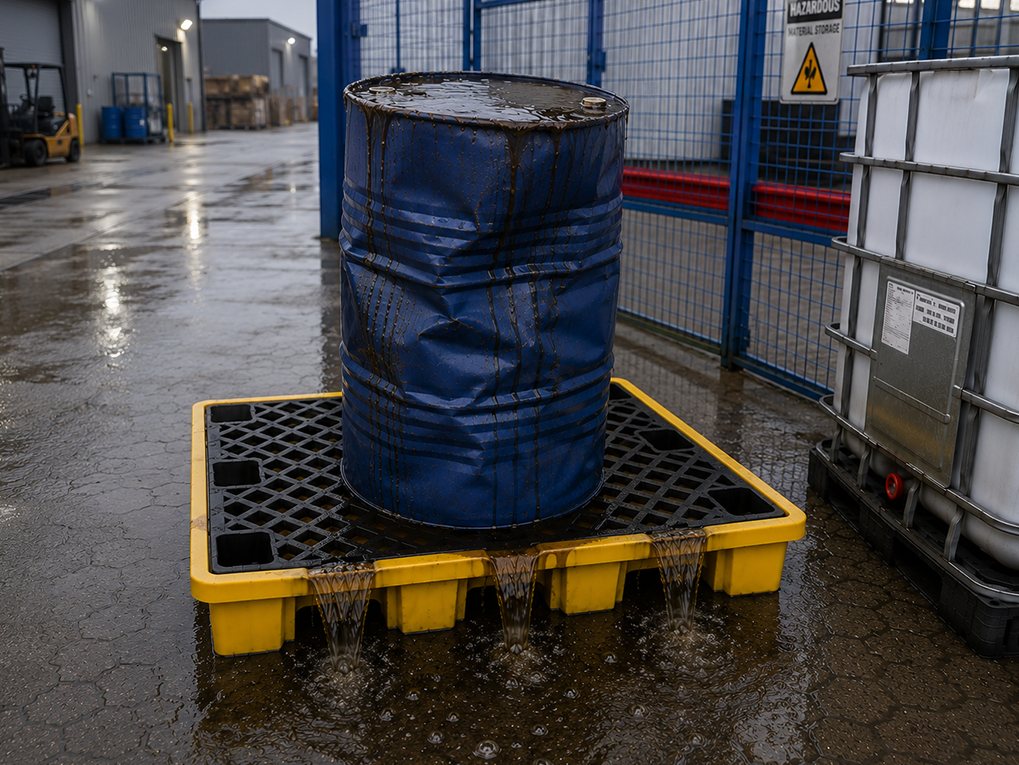
Somewhere on your site, there’s a drum of oily waste waiting for collection. It’s correctly labelled, has its waste code, and its consignment note is ready to go. Once that drum leaves the gate, the information on that note begins its own journey.
Since 1 October 2026, that journey has a new final stop.
Digital waste tracking is now mandatory for permitted waste receiving sites in England and Wales. When that drum reaches its destination, the receiving site has two working days to log it on a government system, field by field. And where does most of that detail come from?
You.
The good news is that if you’re simply a hazardous waste producer, you don’t need to register for anything, upload anything or pay anything ‘extra’. The slightly less good news is that the information you hand over at collection has never been under this much scrutiny.
So, let’s take a look at what’s changed, what hasn’t and what’s worth tightening up before your next collection.
 Why Digital Waste Tracking Matters to Producers Who Don’t Report
Under the Waste Duty of Care, every business that produces waste must take reasonable steps to describe it accurately, so the next person in the chain can handle, transport and treat it safely and legally. None of that is new.
What’s new is where your description ends up. Until now, it largely lived on paper: a consignment note here, a quarterly return there. Now, every load arriving at a permitted site becomes an individual digital record, created within days and visible to regulators looking for anything that doesn’t add up.
That’s the whole point of the system. The government aims to close the information gaps that let waste go missing, get misdescribed, or end up somewhere it shouldn’t.
For hazardous waste producers, an accurate description has always been a legal requirement. Now it’s also a matter of record within days.
When gaps do appear, they’re rarely a sign of carelessness. More often, site shorthand creeps into paperwork because nobody has had the time or support to translate it. Digital waste tracking simply makes those gaps easier to spot.
Digital Waste Tracking in 60 Seconds
Digital waste tracking is a government service built to replace the patchwork of paper notes, spreadsheets and returns that currently follows waste around the country with one connected digital record. It’s being introduced in phases rather than switched on all at once.
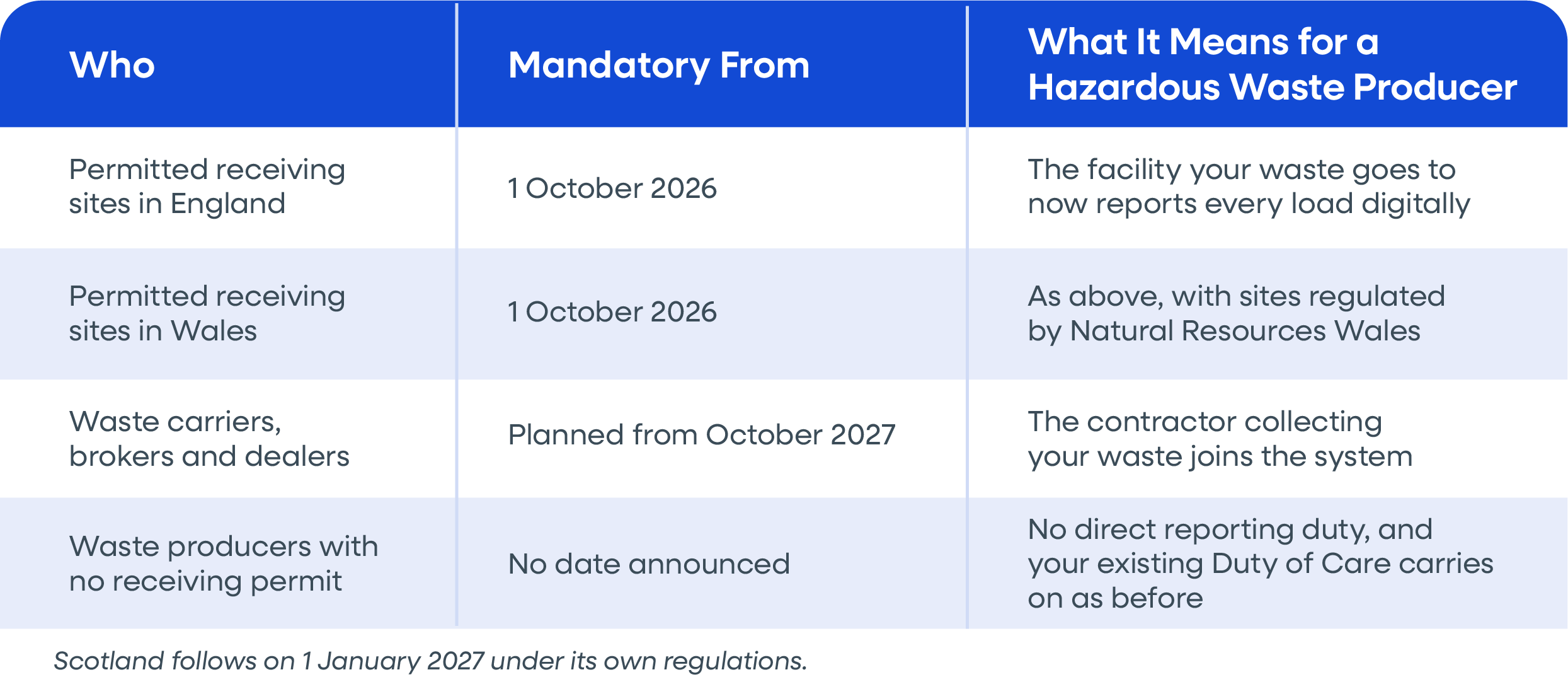
Phase 1 is now live. Under the Digital Waste Tracking (England) Regulations 2026 and the Digital Waste Tracking (Wales) Regulations 2026, operators of sites licensed or permitted to receive controlled waste must record every in-scope load through the government’s ‘Report receipt of waste‘ service.
If you were picturing a single switch-over day where the paperwork vanished and everything moved online, we’re sorry to report the filing cabinet and paper trail survives for now. More on that shortly.
Does Digital Waste Tracking Apply to Waste Producers?
Most manufacturers, laboratories, schools, construction firms, and facilities teams hand their hazardous waste to an authorised contractor, and that’s where their Phase 1 responsibility ends. If that’s you, there’s no Defra account to set up, no annual fee to pay and nothing to upload.
There’s one catch worth knowing about, though, GOV.UK guidance confirms the reporting duty can apply to a permitted receiving activity on the same site where the waste is produced. It’s worth a closer look if your site:
- Runs on-site treatment under an environmental permit.
- Hosts mobile plant deployed under a permit.
- Accepts waste from other sites in your group, or from third parties, under a permit.
- Operates a permitted transfer or storage activity alongside production.
Activities that run solely under registered waste exemptions sit outside Phase 1 and are expected to come into scope in a later phase.
What Should You Do?
Dig out your environmental permits and check exactly which activities they cover. If you can’t tell whether one involves receiving waste, ask your regulator (the Environment Agency in England or Natural Resources Wales in Wales) rather than assuming either way.
Follow the Drum: What Receiving Sites Now Record About Your Waste
The easiest way to see what’s changed is to follow a single 205L drum of waste solvent from a manufacturing site to its destination.
- Your waste area: Someone fills the drum, labels it and describes the waste, ideally with its European Waste Catalogue (EWC) code (the six-digit codes from the List of Waste) and hazardous property (HP) codes confirmed.
- The consignment note: That description, the quantity, the container and the hazards go onto the consignment note, which still travels with the drum.
- The vehicle: The carrier collects it, with its registration details and the vehicle registration noted along the way.
- The gate: The drum arrives at a permitted facility, and the clock starts. The operator has until the end of the second working day after receipt to submit the record and receive a unique reference number. A Thursday delivery has until the end of Monday, as weekends and bank holidays don’t count.
At step four, the receiving site’s record has to cover, among other things:
- Where it came from and how: The carrier and its registration number, any broker or dealer involved, the mode of transport, every vehicle registration and the hazardous waste consignment note code.
- What it is: A waste description and its six-digit EWC code.
- How much, and in what: The weight for each code, whether that weight is actual or estimated, plus the container type and number of containers.
- What makes it hazardous: The relevant HP codes, chemical or biological components and their concentrations, and any persistent organic pollutants (POPs) present.
- How it behaves: Its physical form (gas, liquid, solid, powder, sludge or mixed) and any special handling requirements.
The full list is set out in Schedule 1 of the regulations. Where a site receives hazardous waste under several consignment notes at once, each note counts as a separate load.
A ‘not known’ in a waste description has always been a gap. Now it’s visible, and sitting in a government record within two working days. That’s why receiving sites have every reason to want dependable information from the producers they serve. They face compliance notices, financial penalties, or prosecution if their records fall short, and if they find an error after submitting, they must correct it as soon as possible and within one month of discovering it.
And guess who they’ll call to check the details? So, if your waste contractor starts asking more questions than before, don’t see it as awkwardness. It’s usually a sign the system is working.
The Vague Description Translator
Nobody writes ‘oily waste’ on a drum to cause trouble. It’s quick, it’s familiar, and it’s how most sites talk about their waste. But when that shorthand makes it onto the paperwork, here’s how it reads from the other side of the gate.
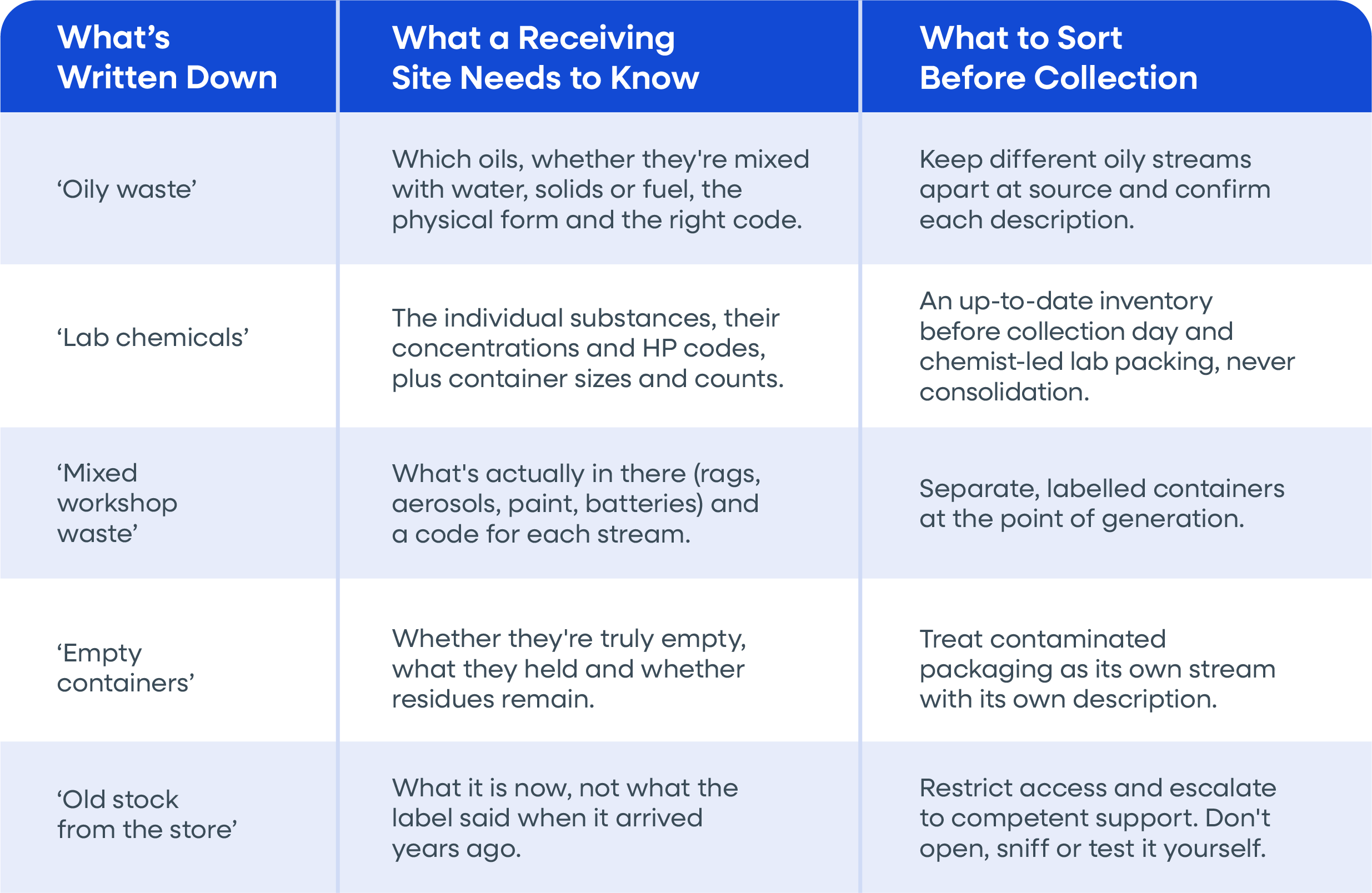
This isn’t a classification guide. Confirming codes and hazards needs competent assessment against the government’s waste classification technical guidance (WM3).
But it shows where gaps tend to appear. If you’re staring at a container nobody can confidently identify, our guide on how to dispose of unknown chemical waste explains the safe next steps.
 Do Hazardous Waste Consignment Notes Still Apply?
Yes. Digital waste tracking adds a record at the receiving end. It doesn’t remove anything at yours.
Government guidance is clear that the existing paper-based processes carry on alongside the new service until further notice. That means:
- Hazardous waste consignment notes still accompany hazardous waste moved from your premises.
- Waste transfer notes still apply to non-hazardous transfers.
- Annex VII forms still apply where relevant.
- Receiving sites still submit their usual waste returns and consignee returns.
Your record-keeping periods haven’t changed either. If you need a refresher, our guide on how long you should keep a hazardous waste consignment note covers it.
What Hazardous Waste Producers Should Do Now
None of the following are new legal duties. They’re practical ways to back up the Duty of Care you already have, and to make sure the information leaving your site is good enough for whoever has to record it next.
Check #1: Map Every Stream, Including the Occasional Ones
Routine streams usually look after themselves, as they’ve been collected the same way for years. It’s the one-offs that catch people out: shutdown waste, spill clean-up debris, a prep room clear-out, legacy chemicals or a pallet of dead batteries. These are the streams most likely to be described in a hurry.
What to do: Keep a simple site-level inventory of every stream, routine or occasional, with its description, code and container type.
Check #2: Retire Your Vaguest Descriptions
Use the translator above as a starting point. If a stranger couldn’t fill in the receiving site’s record using your description alone, it needs more work.
What to do: Pick the three descriptions your site uses most often and test them against that question.
Check #3: Make Your Sources Agree
Your purchase records, Safety Data Sheets (SDS), analysis reports, container labels, waste inventory and consignment notes should all tell the same story. Remember that an SDS describes the product as supplied, not necessarily the waste it became after use. When your sources disagree, somebody downstream has to decide which one to believe, and they’d rather not guess.
What to do: Spot-check one stream from start to finish and see whether the label, the inventory and the last consignment note actually match.
Check #4: Agree Who Fixes What
Weights get estimated. Container counts change on the day. Loads occasionally get queried or rejected. With receiving sites now working to tight correction windows, the ‘who sorts this out?’ conversation is better had before collection day than during it.
What to do: Agree with your waste contractor on who confirms weights, concentrations, codes and corrections, how quickly, and write it into your collection procedures.
Check #5: Check the Chain, Not Just the Collector
Using a waste contractor doesn’t transfer your Duty of Care. You still need to take reasonable steps to make sure your waste goes to authorised people and appropriate destinations. In England, you can check carrier, broker and dealer registrations on the Environment Agency public register.
What to do: Ask your contractor where your waste is going, whether those receiving sites report through the new service, and how they’ll pass any corrections back to you.
Not sure what to ask, or what a good answer sounds like? We’re happy to help.
Speak to a Hazardous Waste Expert
Check #6: Support the People Who Present the Waste
The operatives, technicians, science technicians and site staff who fill, label and stage waste create much of this information, usually while thinking about a dozen other things. Nobody needs a three-hour session on Schedule 1 of the regulations. They need labels, prompts and storage set up so the right information is captured without anyone having to stop and guess.
What to do: Take a five-minute walkaround of your waste area and look for containers that couldn’t describe themselves to a stranger.
 What Happens Next? Collectors Join in 2027
Phase 2 brings waste collectors into the system. That means carriers, brokers and dealers, with a public beta planned from spring 2027 and mandatory use from October 2027. Registered waste exemptions are expected to follow in a later phase.
As a registered waste carrier, we’d be a little hypocritical telling you to get your waste information in order without doing the same ourselves. With that said, we’re ahead of the curve and have been since January 2026, using a digital waste management platform designed to automate and digitise compliance, tracking, and documentation for both hazardous and non-hazardous waste.
For producers, the practical effect is that once collectors join, the digital record is expected to start earlier in the journey, much closer to your waste area. The description you hand over at collection will matter sooner, not later.
As of now, no date has been announced for waste producers to report directly. If someone tells you otherwise, it’s fair to ask them for the source.
 Remove the Guesswork with Hazport
At Hazport, we help hazardous waste producers across the UK get their waste properly identified, described and on its way, with:
- Mobile chemists who can attend site to identify, classify and package waste.
- Expert-led waste audits and risk assessments.
- Lab packing and chemical waste disposal for small, mixed or legacy streams.
- Waste paperwork safely stored on a digital database and accessible through a customer portal.
- A cradle-to-grave hazardous waste disposal service, from identification to final disposal.
Your Duty of Care stays with you, but that doesn’t mean you have to carry it alone.
Contact us today to find out how our hazardous waste disposal services can help make sure your waste information is ready for whoever needs to record it next.